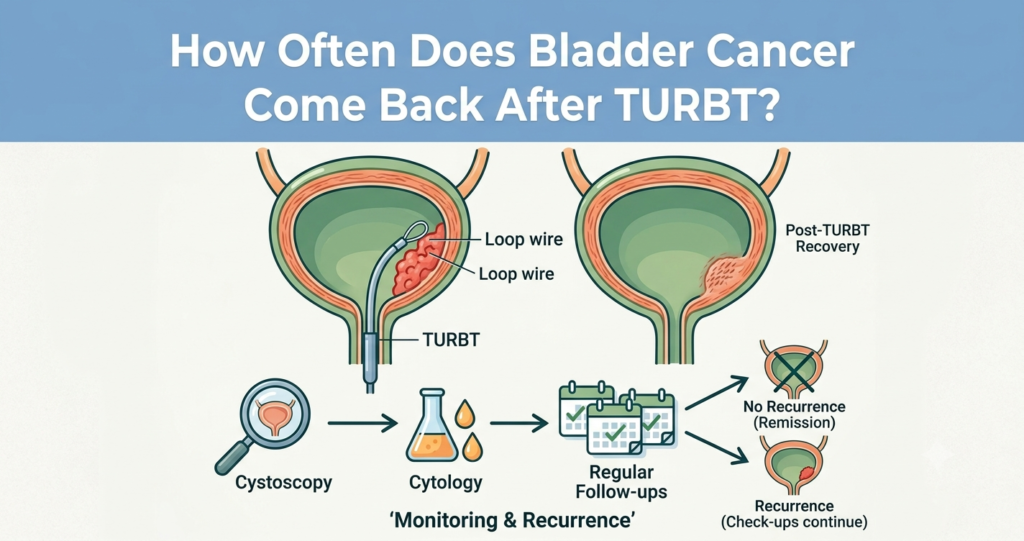

Quick answer: Bladder cancer comes back after TURBT in anywhere from 15% to over 80% of cases, and the honest answer is “it depends which patient you are.” Low-risk tumors recur in roughly 20-30% of cases over five years. High-risk and very-high-risk tumors recur in 70-85% of cases over the same period. The single biggest predictor isn’t the surgery — it’s the tumor’s grade, size, and number at diagnosis.
You just had a TURBT. The surgeon says they got it all. So why does your urologist still want to see you back in three months, then every few months after that, possibly for years?
Here’s the uncomfortable truth nobody puts on the consent form clearly enough: TURBT removes the tumor you can see. It doesn’t change the fact that your bladder lining produced that tumor in the first place, and it can produce another one. That’s not a surgical failure. It’s just how this particular cancer behaves.
Let’s get into actual numbers — and why the number that matters for you might look nothing like the number that matters for the guy in the waiting room next to you.
Why Bladder Cancer Has Such a High Comeback Rate
Non-muscle invasive bladder cancer (NMIBC) — the type TURBT treats — is what doctors call a “field disease.” The entire urothelium, the lining of your bladder, has been exposed to whatever caused the first tumor: cigarette smoke byproducts, industrial chemicals, chronic irritation, or in some cases nothing identifiable at all. Roughly 75% of all bladder cancer patients present with this non-muscle-invasive form, and up to 70% of them will see it recur at some point.
That’s the part most patient handouts skip. TURBT isn’t curing an underlying tendency. It’s removing visible tumors from a bladder lining that may keep generating new ones, sometimes for years.
The Real Recurrence Numbers, by Risk Group
Doctors don’t quote one universal recurrence rate, because there isn’t one. According to The European Association of Urology (EAU) sorts NMIBC patients into four risk categories, and the recurrence rates between them are night and day.
| Risk Group | 5-Year Recurrence Rate | 5-Year Progression Risk |
|---|---|---|
| Low risk | ~20-30% | Negligible (under 2%) |
| Intermediate risk | ~45-55% | Low to moderate |
| High risk | 73-84% | 8.1-14% |
| Very high risk | Comparably high, often treated with early cystectomy discussion | 29-54% |
Immediate intravesical chemotherapy after TURBT cuts the five-year recurrence rate from 45% down to roughly 59% versus 45% — wait, let’s be precise here: TURBT alone carries roughly a 45% five-year recurrence rate, while a single chemotherapy instillation right after surgery brings that down meaningfully, with progression staying under 2% at five years for low-risk patients.
Where do these risk categories come from? Not guesswork. The scoring system weighs the number and size of tumors removed, how deep they’d invaded, whether you’ve had prior recurrences, the presence of carcinoma in situ, and the tumor’s grade after TURBT. Plug those into the EAU’s calculator and you get your personal risk band — which matters a lot more than the procedure itself.
What “Recurrence” Actually Means (It’s Not Always Bad News)
Recurrence sounds terrifying, but context matters enormously here. Most bladder cancer recurrences are the same low-grade, non-invasive type as the original tumor — caught early at a routine cystoscopy, removed in a quick repeat procedure, and not life-threatening. Progression — meaning the cancer becomes muscle-invasive — is a separate, far less common event, and it’s the one your care team is really watching for.
One sharp distinction worth sitting with: a tumor “coming back” within the first year often isn’t even a true new cancer. It may be tissue your surgeon couldn’t fully see or reach the first time.
Early Recurrence vs. Late Recurrence — and Why It’s Often Not a New Cancer
Researchers split recurrences into early (within one year) and late (after one year), and the causes behind each look pretty different. Among more than a thousand patients followed after TURB, early recurrence was linked to tumor location on the posterior or lateral bladder walls, flat or sessile tumor shape, incomplete initial resection, and high-grade histology — while late recurrence was more tied to resections that didn’t reach the muscle layer and to low-grade tumors.
Translation: early recurrence often points to residual tumor left behind, not a brand-new cancer. That’s exactly why doctors push so hard for a thorough first resection — and why some patients get a second, “repeat” TURBT just weeks after the first.
The Repeat TURBT Nobody Warns You About
If your tumor was high-grade or invaded the layer just under the bladder lining (called T1), your urologist will likely schedule a second resection within six to eight weeks — before you’ve even had a chance to recover fully from the first one. This isn’t overcaution. Studies looking at repeat resections found tumor persistence rates of 27.7% for Ta tumors and 34.6% for T1 tumors — meaning roughly a third of the time, cancer cells were still sitting there after a resection that looked complete.
The flip side is reassuring: upstaging — discovering the cancer was actually more advanced than first thought — happened in only about 3-4% of repeat resections, and aggressive, deep initial surgery lowered both numbers. A good surgeon, in other words, buys you better odds before recurrence even enters the conversation.
Your Surveillance Schedule, Explained (Not Just Listed)
That string of follow-up cystoscopies feels relentless, but each one has a reason. Every NMIBC patient gets a cystoscopy at three months after TURBT, regardless of risk group — it’s one of the strongest predictors of how the next few years will go. What happens after that first check splits by risk.
| Risk Group | Typical Follow-Up Schedule |
|---|---|
| Low risk | First cystoscopy at 3 months; if clear, next one at 6-9 months, then annually |
| Intermediate / High risk | Cystoscopy every 3-6 months initially, tapering as time passes without recurrence |
| Very high risk | Often every 3 months for the first two years, then every 6 months through year five |
Why not just rely on a urine test instead of a scope every few months? Because nothing else comes close. Urinary markers and cytology can’t replace cystoscopy in most situations — cystoscopy still has the highest sensitivity and specificity for catching these tumors early. It’s not fun. It’s also the reason recurrences get caught small instead of dangerous.
What Actually Drives Your Personal Recurrence Risk
If you’re trying to figure out where you personally land, here’s what’s actually been shown to matter — not internet folklore, the studied factors. Older age, female sex, a history of smoking, large tumor size, multiple tumors at once, high tumor grade, and high stage all push recurrence risk upward. Having multiple tumor sites at diagnosis specifically more than doubled the risk of recurrence within five years in one study of 151 patients.
None of these are things you caused by doing something “wrong” after surgery. They’re baked into the tumor biology before TURBT ever happens. Worth saying plainly, because plenty of people quietly blame themselves here.
Can You Lower Your Own Recurrence Odds?
Yes, actually — and this is where competitor content tends to go vague. Quitting smoking is the single most controllable factor; smoking history is a consistently documented risk factor for recurrence, not just for getting bladder cancer in the first place. Showing up for every scheduled cystoscopy, even when you feel fine, is the second most important thing you control. Skipped surveillance appointments are how early recurrences turn into late, harder-to-treat ones.
Beyond that, treatment compliance counts for a lot. An immediate dose of chemotherapy delivered into the bladder right after TURBT measurably reduces recurrence risk for non-muscle-invasive bladder cancer, and for intermediate- and high-risk patients, completing the full course of BCG immunotherapy — even when it’s uncomfortable — matters more than people expect.
When Recurrence Means a Bigger Conversation
Most recurrences mean another TURBT and a return to surveillance. But repeated procedures carry their own cost. If TURBT needs to be repeated many times, the bladder can scar and lose some of its capacity to hold urine, which can cause frequent urination or incontinence. For patients in the very-high-risk category, or anyone whose tumors keep returning aggressively despite BCG, your urologist may eventually raise the option of removing the bladder altogether — a cystectomy. That’s not a failure on your part. It’s a recognition that, for some tumor biology, surgery on the whole organ offers better long-term odds than chasing recurrences indefinitely.
The Bottom Line
There’s no single number that answers “will my cancer come back.” What there is: a risk category specific to your tumor, a surveillance schedule built around catching anything early, and a set of choices — quitting smoking, finishing your treatments, never skipping a scope — that genuinely move the odds. Ask your urologist directly which risk group you fall into. That conversation will tell you more than any statistic in this article.
Frequently Asked Questions
How soon after TURBT can bladder cancer come back?
It can show up at the very first follow-up cystoscopy, typically scheduled three months after surgery. Recurrences within the first year are often residual tumor that wasn’t fully visible during the original resection, rather than a brand-new growth.
What percentage of bladder cancer comes back after TURBT?
It ranges from about 20-30% for low-risk tumors over five years to 70-85% for high-risk and very-high-risk tumors over the same period. TURBT alone, across all risk groups combined, carries roughly a 45% five-year recurrence rate.
Does recurrence mean the cancer is getting worse?
Not usually. Most recurrences are the same low-grade, non-invasive type as the original tumor and are treated with another TURBT. Progression to muscle-invasive disease is a separate, less common outcome that your surveillance schedule is specifically designed to catch early if it happens.
How many TURBTs can someone have over a lifetime?
There’s no fixed limit, but repeated procedures can scar the bladder and reduce its capacity over time. For patients with frequent low-grade recurrences, doctors sometimes switch to in-office fulguration instead of full TURBT to reduce cumulative trauma to the bladder.
Why do I need a second TURBT so soon after the first?
If your tumor was high-grade or invaded the layer beneath the bladder lining, a repeat resection within six to eight weeks checks for residual tumor cells the first surgery may have missed. Studies have found persistence rates of roughly 28-35% in this scenario, which is why the second look matters.
Can lifestyle changes lower my recurrence risk?
Quitting smoking is the most significant controllable factor, since smoking history is consistently linked to higher recurrence rates. Attending every scheduled surveillance cystoscopy and completing prescribed intravesical chemotherapy or BCG courses also meaningfully reduce risk.
How long do I need cystoscopy follow-ups after TURBT?
For low-risk patients with no recurrence, surveillance often extends for at least five years before shared decision-making determines whether to continue. Higher-risk patients are frequently followed for ten years or longer, since recurrence risk persists well beyond the initial diagnosis.
What’s the difference between recurrence and progression?
Recurrence means a new tumor of the same non-muscle-invasive type has appeared. Progression means the cancer has advanced to a more aggressive stage, typically becoming muscle-invasive. Recurrence is common; progression is far less common and is what intensive surveillance is designed to catch early.
This article is for general information and does not replace a conversation with your urologist about your specific risk group and follow-up plan. Sources include the European Association of Urology Non-Muscle-Invasive Bladder Cancer Guidelines, the American Urological Association, and peer-reviewed studies on TURBT outcomes